Mock any API.Run it yourself.
MimiQ360 is a mock API server you run yourself. Point your test suite at it instead of a shared sandbox that’s flaky, rate-limited, or not written yet. It’s one JAR, and Java 25 is the only thing you need installed.
Free for non-commercial use. Java 25 is the only prerequisite.
- One JAR
- Download it and run it
- Java 25
- The only prerequisite
- 5 protocols
- HTTP · WS · SSE · gRPC · GraphQL
- Self-hosted
- Runs on your hardware
The problem
Most flaky tests aren’t your fault.
A test suite that calls a real service is only ever as healthy as that service. The shared sandbox goes down mid-sprint. Someone burns through the rate limit before your run finishes. The endpoint you’re coding against hasn’t been written yet. The build goes red and there’s nothing in your diff to fix.
The sandbox is shared
One environment, three teams, and test data somebody else keeps changing under you.
Every call is metered
Rate limits and per-call pricing mean you think twice before running the whole suite.
It isn’t built yet
You’re coding against an endpoint the other team hasn’t finished, and neither of you wants to block on the other.
MimiQ360 replaces that service with one you run yourself.
Capabilities
A mock that behaves like a real service.
A static stub hands back the same JSON forever. This one keeps state, controls timing, speaks five protocols, and fails on cue when your test needs it to.
Define it from what you have
Import an OpenAPI spec, a HAR capture from your browser, a Postman collection, a curl command, a WSDL or a CSV. If there’s nothing to import, write a few lines of YAML or click it together in the web UI.
Five protocols, one server
HTTP, WebSocket, SSE, gRPC and GraphQL. Templated responses, match rules, latency and fault injection work the same way across all five.
Stateful flows
MFL is a small state machine language that picks the response at request time. An order can move from pending to shipped over several calls instead of answering the same way forever.
A virtual database
Flows read and write actual records, so a multi-step scenario remembers what happened. Seed it, reset it between tests, or drop it straight into the state you want to check.
Proxy and record
Point it at the real service, capture what comes back, and replay that from then on. You hit production once and never again.
Built to run in CI
There’s a GitHub Action, a GitLab template, and a CLI with serve, push, pull, validate and reset. The mocks on your laptop are the mocks the pipeline runs.
The product
See what your mocks are doing.
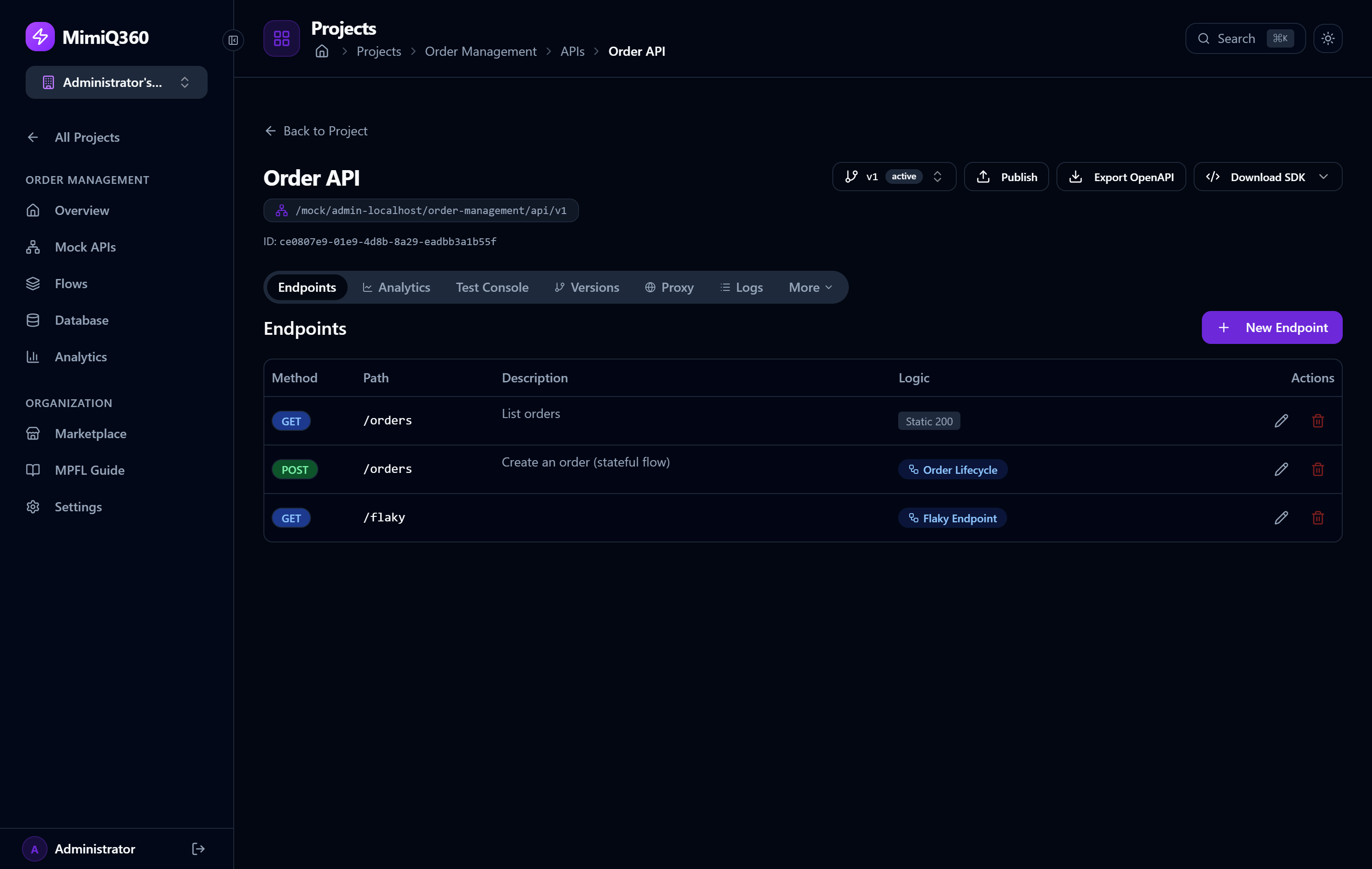
A web console for your mocks, the flows behind them and every request they’ve served.
Endpoints. Every route in a Mock API, each one returning a fixed response or delegating to a flow. Publish, version and export OpenAPI from the same screen.
How it works
From spec to running mock.
- 01
Import your spec
An OpenAPI spec, a HAR capture or a Postman collection. If there isn’t a spec yet, a dozen lines of YAML will do.
- 02
Give it behavior
Add match rules, latency and the failures you want to test against. If the mock needs to remember things, write a flow in MFL and back it with the virtual database.
- 03
Point your tests at it
One command starts the server, and it reloads as you edit the file. The same file runs unchanged in CI.
Self-hosted
One JAR. Your machine.
Dev mode gives you a server with your mocks live, an embedded PostgreSQL and hot reload when the file changes. Ctrl-C stops it and takes the data with it, which is what you want from a test fixture. Run the full application instead and you get the web UI, accounts, projects and change history on port 8080, all out of the same JAR on your own hardware.
- Distribution
- Single executable JAR
- Runtime
- Java 25 · Spring Boot 4
- Storage
- Embedded PostgreSQL
- Also included
- Docker Compose · Helm
$ java -jar mimiq360.jar serve mocks.yaml MimiQ360 v0.1.0 dev mode (no login, no persistence) Embedded PostgreSQL ready 3 endpoints live on http://localhost:8080 Watching mocks.yaml for changesFAQ
Things people ask first.
Download
Stop testing againstsomeone else’s uptime.
Tell us a little about where you work and we’ll email you a link. One JAR, Java 25, and it runs on your own hardware.
Free for non-commercial use. Commercial and enterprise use requires a paid licence.